The EEA-ESEM 2026 congress in Dublin starts tomorrow. I’ve come to enjoy making my own visualisations to navigate big conferences. Hopefully, this also helps you navigate the conference.
I’m presenting at this one too. My job market paper is on school shootings, residential mobility and neighbourhood segregation, so I spend a fair amount of time thinking about who moves after something bad happens, and who is left behind. More on my session at the bottom.
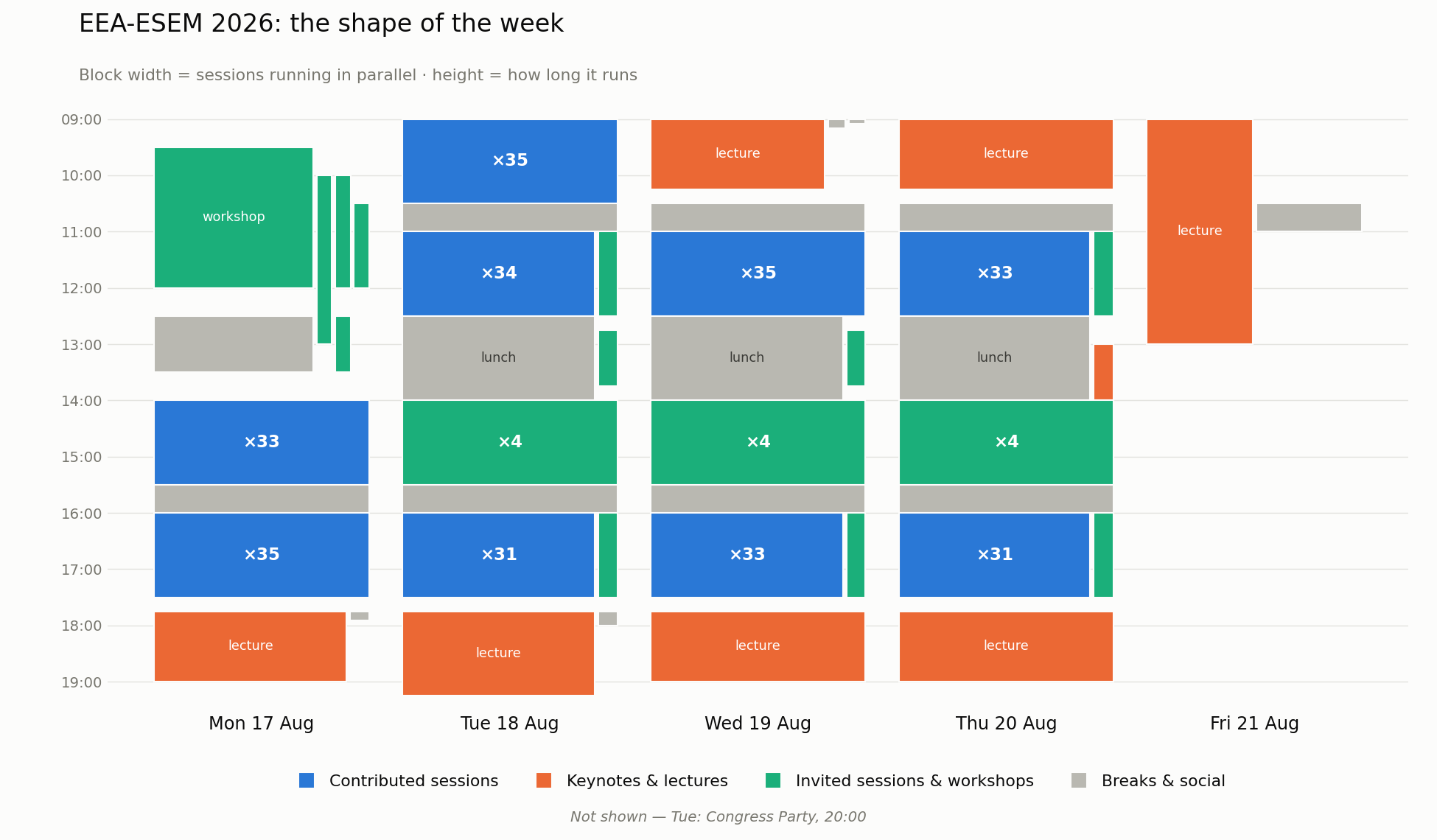
How big is the conference? 337 sessions, 1,163 papers, and 1,129 people listed in the presenter directory, spread over five days. 300 of those sessions are contributed, the rest are keynotes, invited sessions, panels and workshops. 213 sessions sit on the EEA side and 123 on the ESEM side, with exactly one shared between the two.
How does one pick where to go, with, when it’s busiest, 35 sessions running in parallel.
Who is coming, and from where? I remember people by their university or country of residence. But it was difficult to find people by either of these parameters in the website. I asked my buddy Claude (who helped create these visualizations and who came up with the fantastic pun in the title) to go through the list of presenters and look up in which country each institute is located. Classification may contain errors.
As the pun in the title says, participants are here from all over the European Economic Area, or so it seems. Below is a searchable directory of everyone on the programme. Click on a country to see which institutions are represented, then click an institution to see its people and which sessions they’re present in. You can also search for a name directly in the search box.
If it doesn’t load above, you can also open it in a new tab.
Try it with my name, Demetry, and you’ll find where I’ll be standing on Tuesday afternoon.
At the top of the table we have the United States (161 people), Germany (151) and the United Kingdom (137), then a gap to France on 69 and Spain on 54. Ireland going strong with 44 researchers.
Which institutions are they affiliated with?
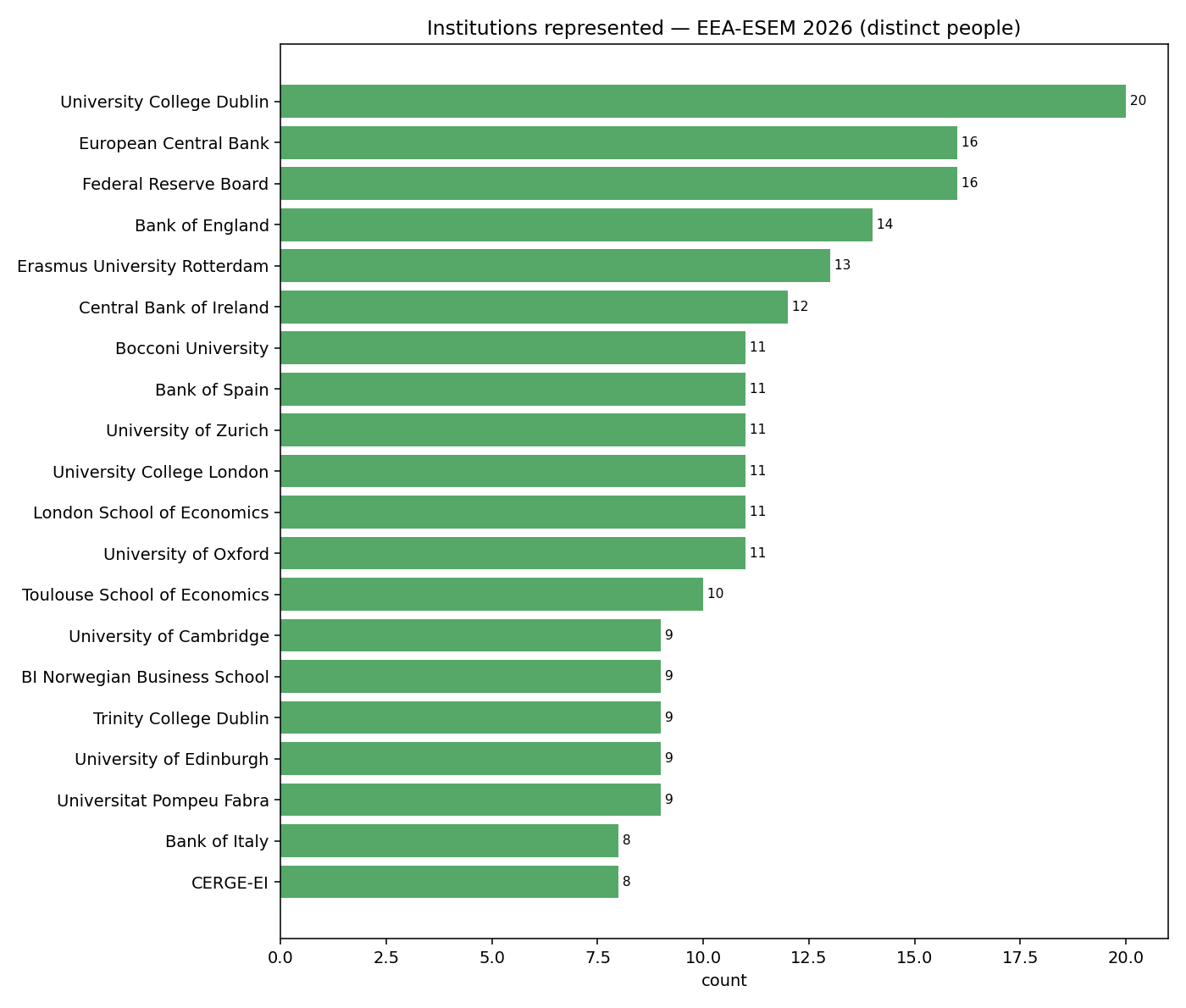
There are 523 institutions (once Claude accounted for spelling variants). There is a strong presence of central banks: the ECB, the Fed Board, the Bank of England, the Central Bank of Ireland and the Bank of Spain.
Which topics are most prominant?
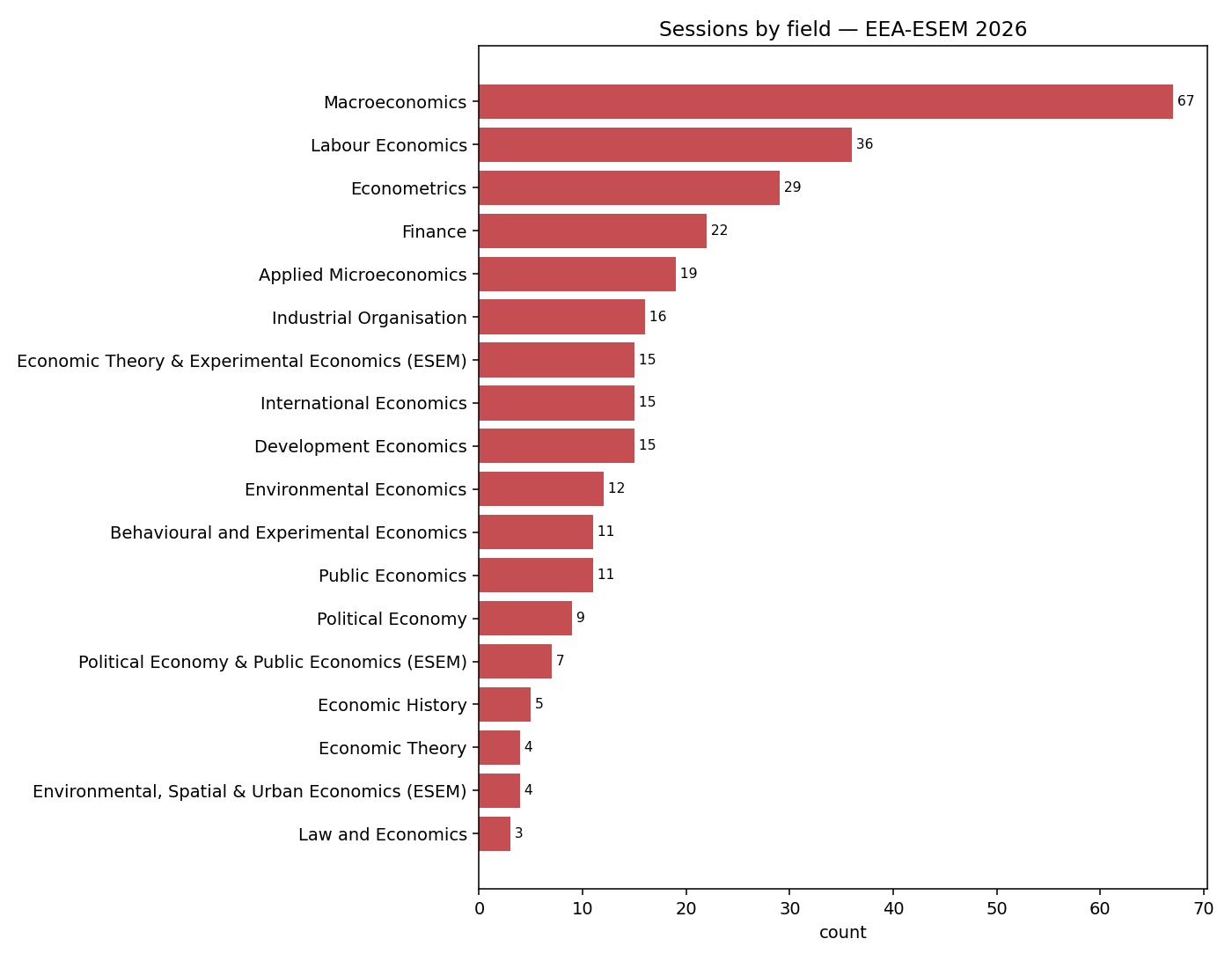
Since sessions are tagged by field we can inspect the distribution of fields. There is a lot of macro, followed by labour, econometrics and finance.
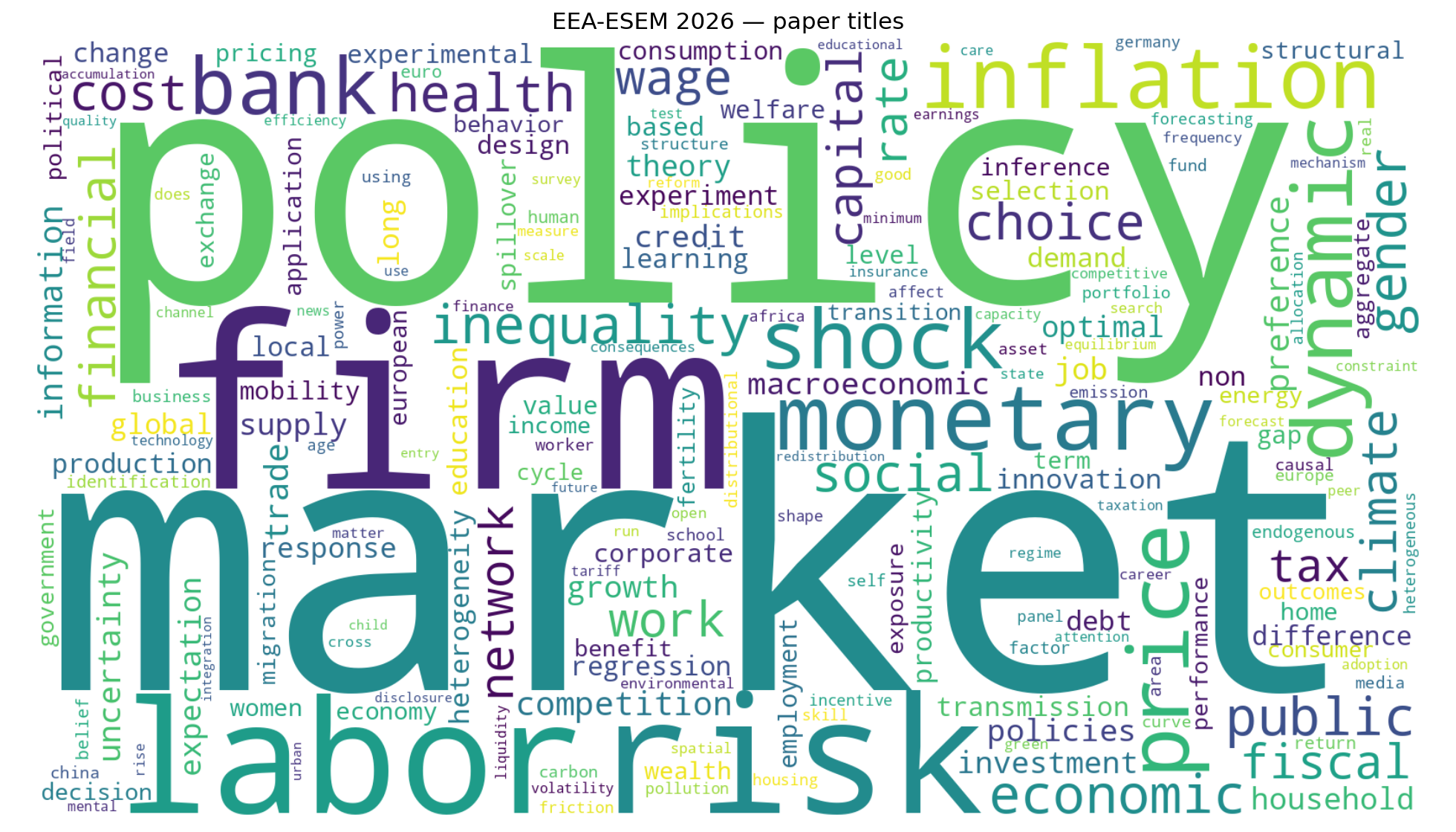
There is a clear policy focus in this conference. From the paper titles, the most common words are ‘market’, ‘policy’, ‘firm’, ‘labor’, and ‘risk’.
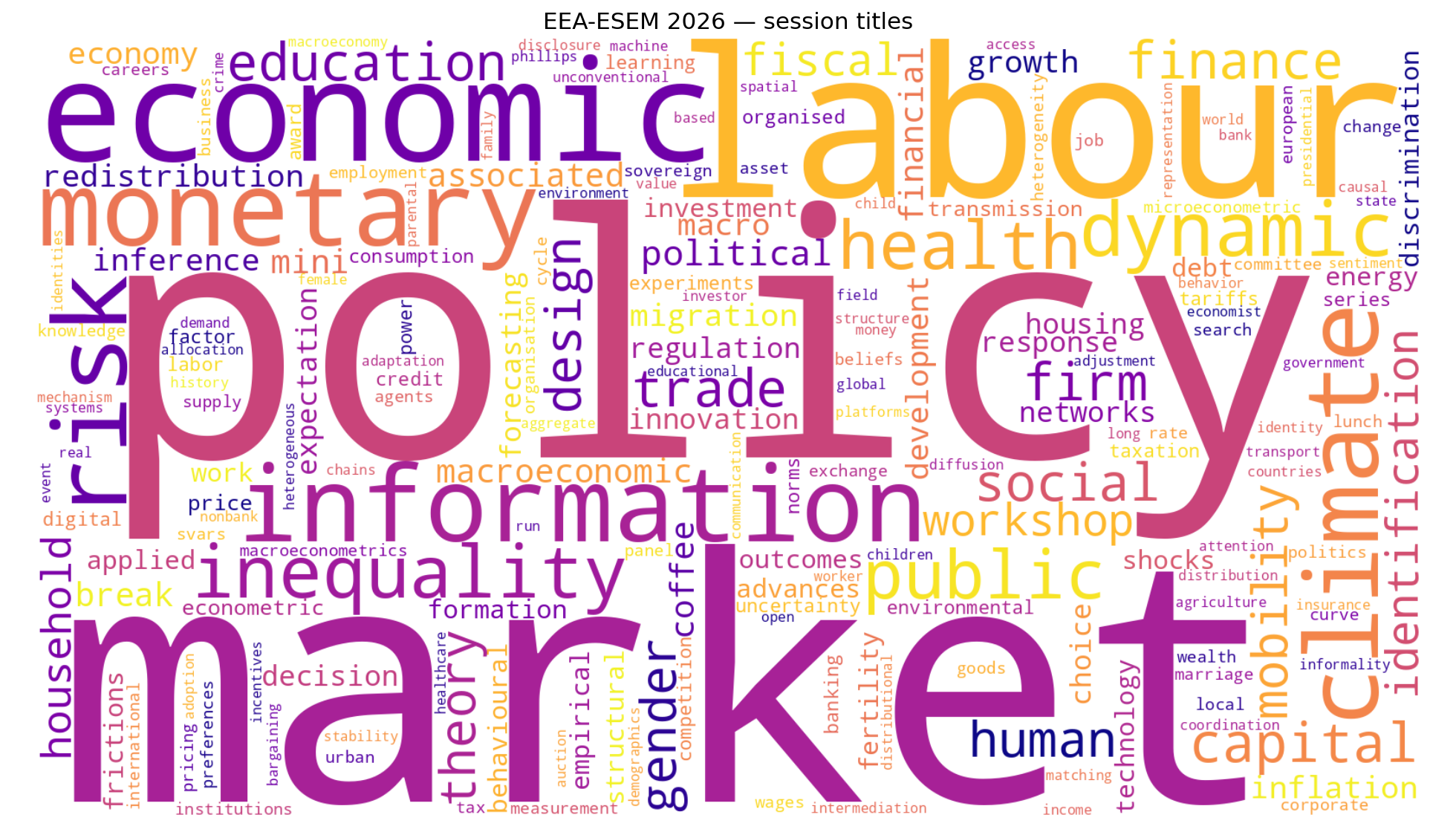
We can do something similar using session titles, which are chosen by the programme committee rather than by authors.
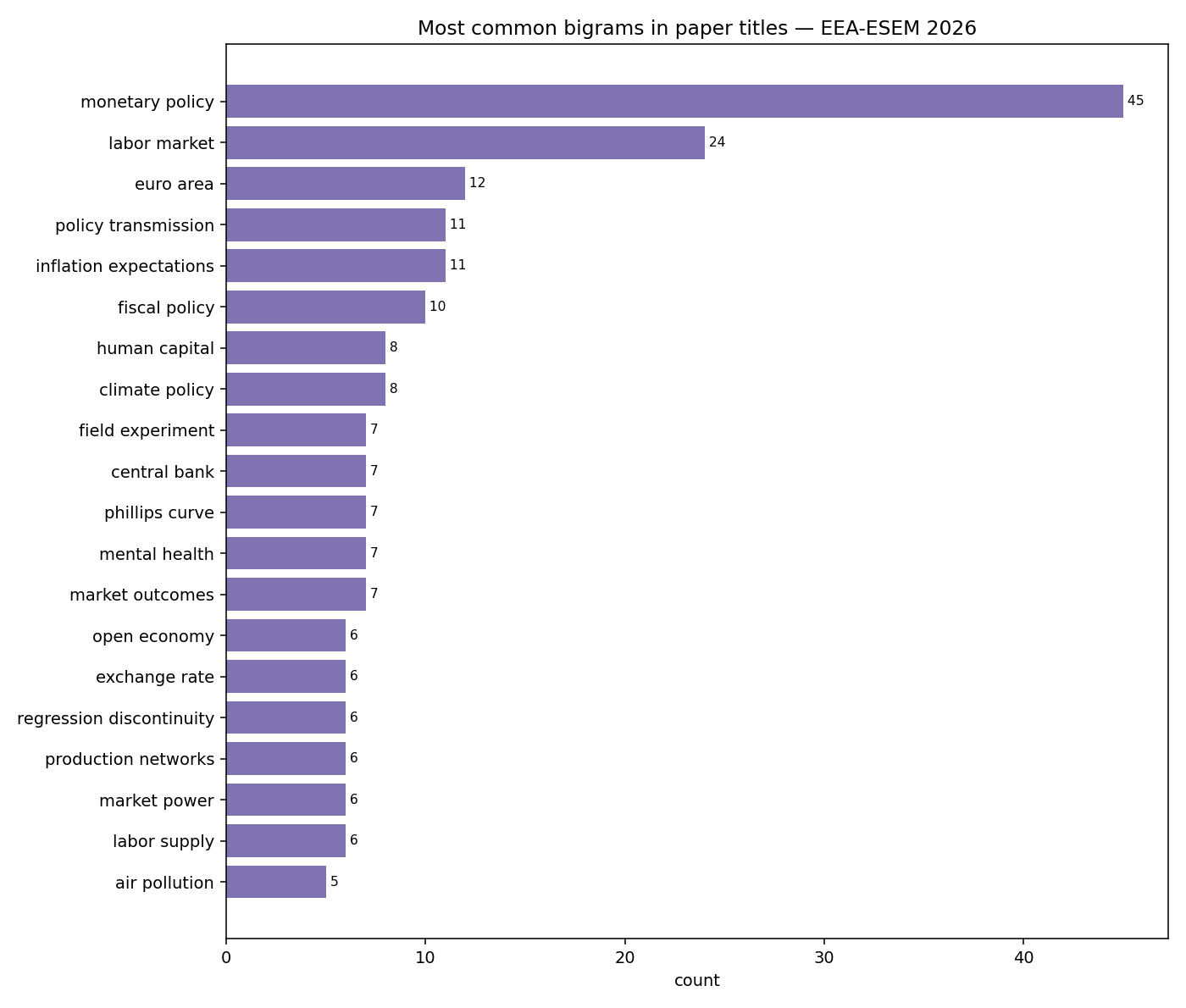
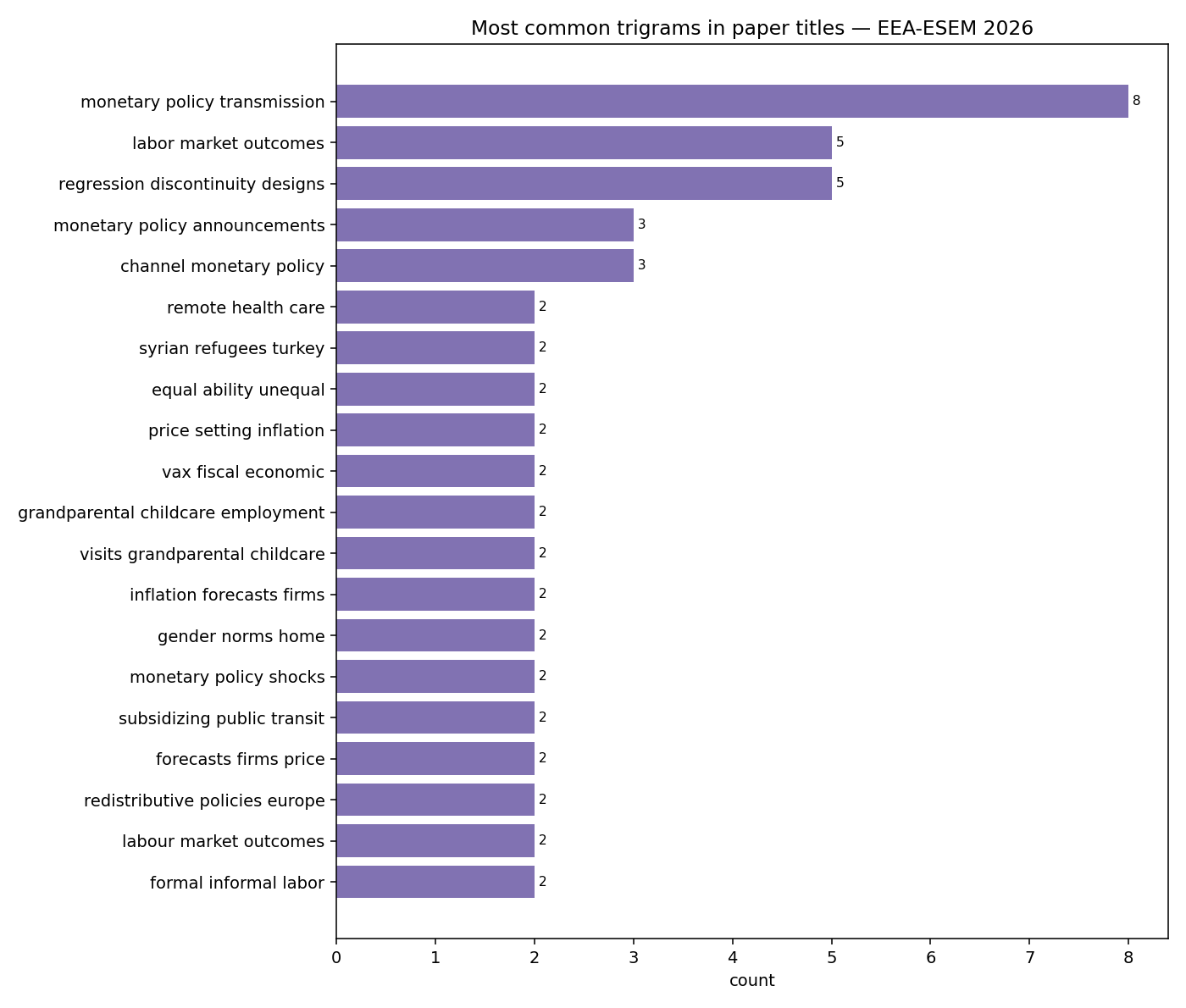
Single words only get us so far. Bigrams and trigrams are more informative. The bigram monetary policy appears in 45 paper titles, nearly twice as often as labor market, and monetary policy transmission is the single most common three-word phrase in the programme.
No network this year It’s a shame we cannot see co-authorships in the programme, otherwise I would’ve done a nice co-authorship network figure, like I did here for SOLE-JOLE.
Where you can find me I’m chairing Migration, Mobility and Spatial Adjustment on Tuesday 18 August at 16:00, in OB ALE 1 (E117/118), and presenting my job market paper there: Flight from Fights: School shootings, mobility and neighborhood segregation. Alexander Yarkin and Mehmet Fatih Ulu are on before me, on student migration and worker mobility, so it’s a full session of people moving around.
I hope to see you there and to grab a coffee!
Uploaded 2026-08-16